Shaft that transmits power from the transmission to the axle differential assembly on rear-wheel-drive vehicles.Checked 2026-08-16
Drive shaft and CV joint
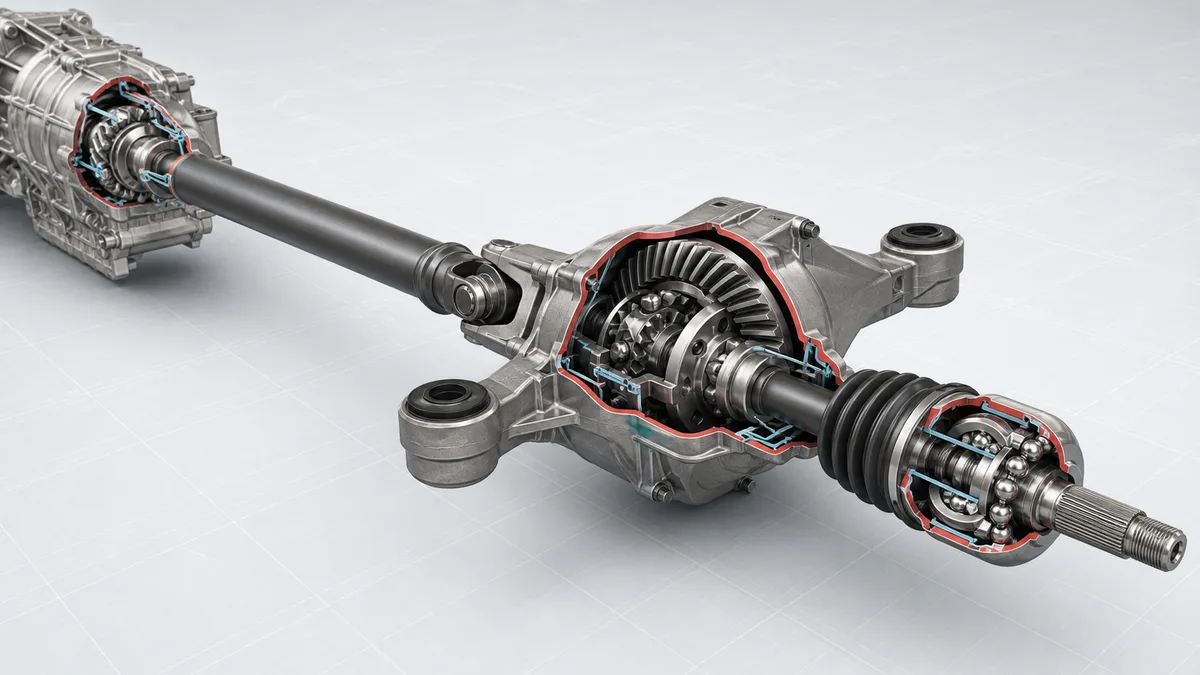
Shafts and flexible joints that carry torque from the transmission or differential to the driven wheels.
Also called: driveshaft · propeller shaft · CV axle · half shaft · constant-velocity joint
What it means
Definition
A drive shaft carries torque along the vehicle, commonly from a transmission or transfer case to a differential. Half shafts carry torque from a differential or transaxle to the wheels. Constant-velocity joints at their ends allow the shaft to work through steering and suspension movement while transmitting rotation smoothly.
Why a buyer cares
What it changes
These names locate different parts of the driveline. A torn CV boot may be serviceable before the joint wears; a vibration from a long drive shaft is a different inspection from clicking at a front CV joint.
In practice
Where you meet it
On underbody inspections and estimates naming a drive shaft, half shaft, CV axle, CV joint or CV boot.
Two things that look alike
Not the same as
A wheel bearing supports the rotating hub; a CV joint transmits drive torque through an angle.
Read next
Related terms
Differential
The gearset that sends torque to two wheels while allowing them to turn at different speeds in a corner.
Front-wheel drive and rear-wheel drive
FWD sends engine power to the front wheels; RWD sends it to the rear wheels.
Wheel bearing and hub
The low-friction bearing and hub assembly that supports the wheel while allowing it to rotate.
Transfer case
The unit behind the transmission that splits drive between the front and rear axles.
Where this comes from
Sources
Refined version of a universal joint, typically used on front-wheel-drive vehicles or rear independent suspensions of rear-wheel-drive vehicles to help reduce vibrations inherent in normal universal jointsChecked 2026-08-16
Driveline layout and joint type vary by vehicle.