They support the drivetrain, chassis and payload and stabilize against internal and external forces.Checked 2026-08-16
Wheel bearing and hub
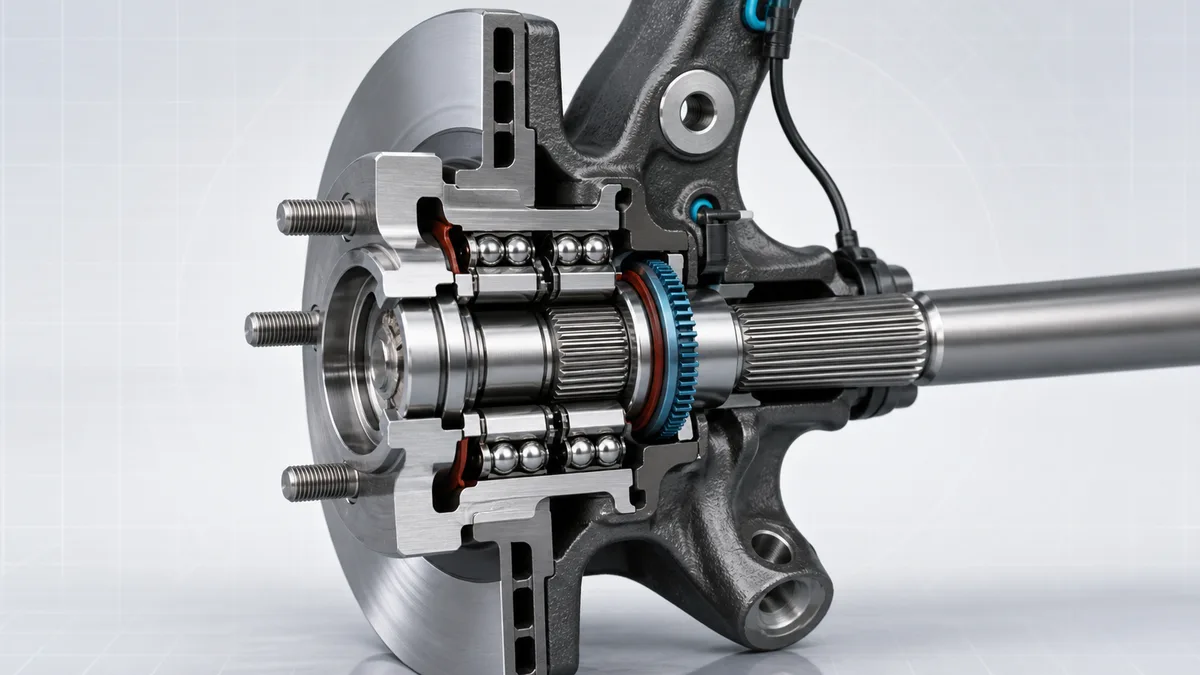
The low-friction bearing and hub assembly that supports the wheel while allowing it to rotate.
Also called: hub bearing · wheel hub assembly · bearing unit
What it means
Definition
A wheel bearing carries vehicle weight and cornering loads while allowing the hub and wheel to rotate with low resistance. On many modern cars it is supplied as a sealed hub unit, sometimes with the ABS encoder or wheel-speed sensing element integrated into the assembly.
Why a buyer cares
What it changes
A wheel bearing, tire and CV joint can all create speed-related noise, but they are different parts. An integrated encoder also means a bearing or hub problem can affect an ABS signal.
In practice
Where you meet it
On suspension inspections and estimates naming wheel bearing, hub assembly, hub unit or ABS encoder ring.
Two things that look alike
Not the same as
The hub and bearing support rotation; the CV joint transmits drive torque; the tire contacts the road.
Read next
Related terms
Wheel-speed sensor
A sensor at each wheel that reports rotation speed to ABS, stability-control and related systems.
Drive shaft and CV joint
Shafts and flexible joints that carry torque from the transmission or differential to the driven wheels.
Anti-lock Braking System (ABS)
The part of the brake system that controls wheel slip during braking so the wheels do not lock.
Where this comes from
Sources
The wheel bearing transmits the power of the drive to the wheels and should therefore generate as little friction as possible.Checked 2026-08-16
Some bearings press into a separate hub; others are replaced as one complete unit.