The term "parking brake" is defined in 49 CFR 571.3 as "a mechanism designed to prevent the movement of a stationary motor vehicle."Checked 2026-08-16
Parking brake
A separate mechanism designed to hold a stationary vehicle, operated by a lever, pedal or electronic switch.
Also called: handbrake · emergency brake · e-brake · electronic parking brake · EPB
What it means
Definition
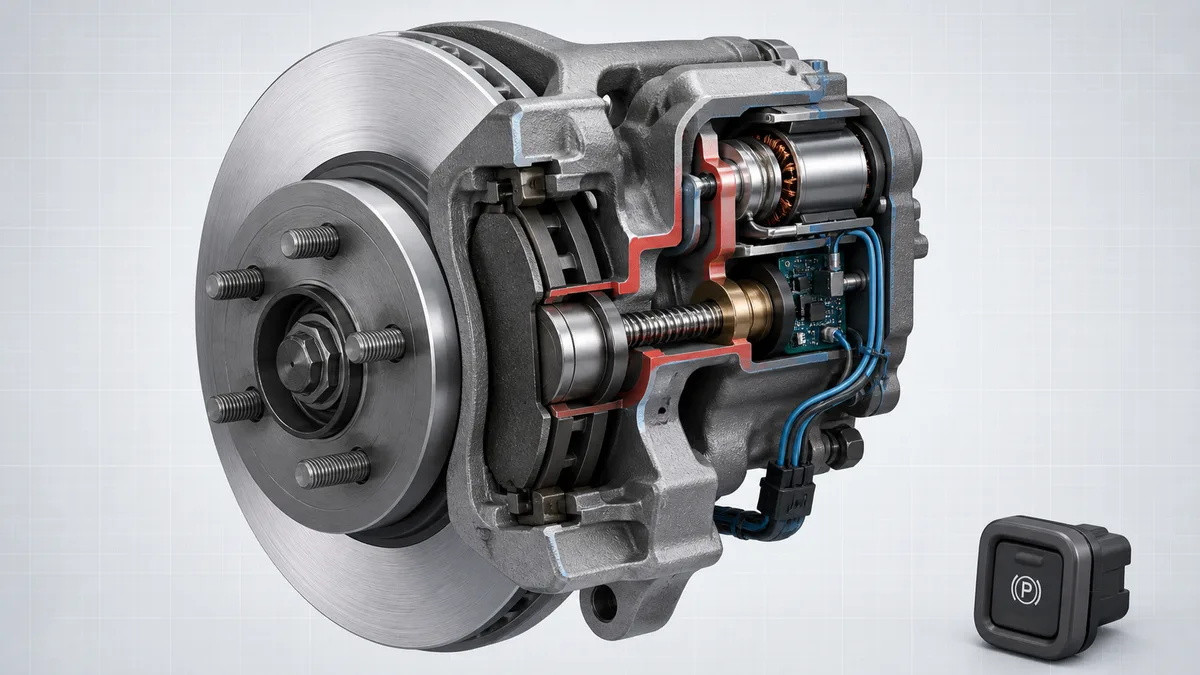
Federal rules define a parking brake by its job: preventing a stationary motor vehicle from moving. The driver may apply it with a hand lever, foot pedal or electronic switch. Even an electronic parking brake is distinct from selecting Park in an automatic transmission.
Why a buyer cares
What it changes
The transmission’s Park position uses a parking pawl inside the gearbox; the parking brake holds through the brake mechanism. Using the parking brake avoids asking one gearbox component to hold the vehicle by itself on a slope.
In practice
Where you meet it
As a lever, pedal or P-marked switch and as a red parking-brake indicator in the instrument cluster.
Two things that look alike
Not the same as
Park is a transmission position; the parking brake is a braking mechanism.
Read next
Related terms
Where this comes from
Sources
The mechanism can act through rear calipers, dedicated drum shoes or other vehicle-specific hardware.