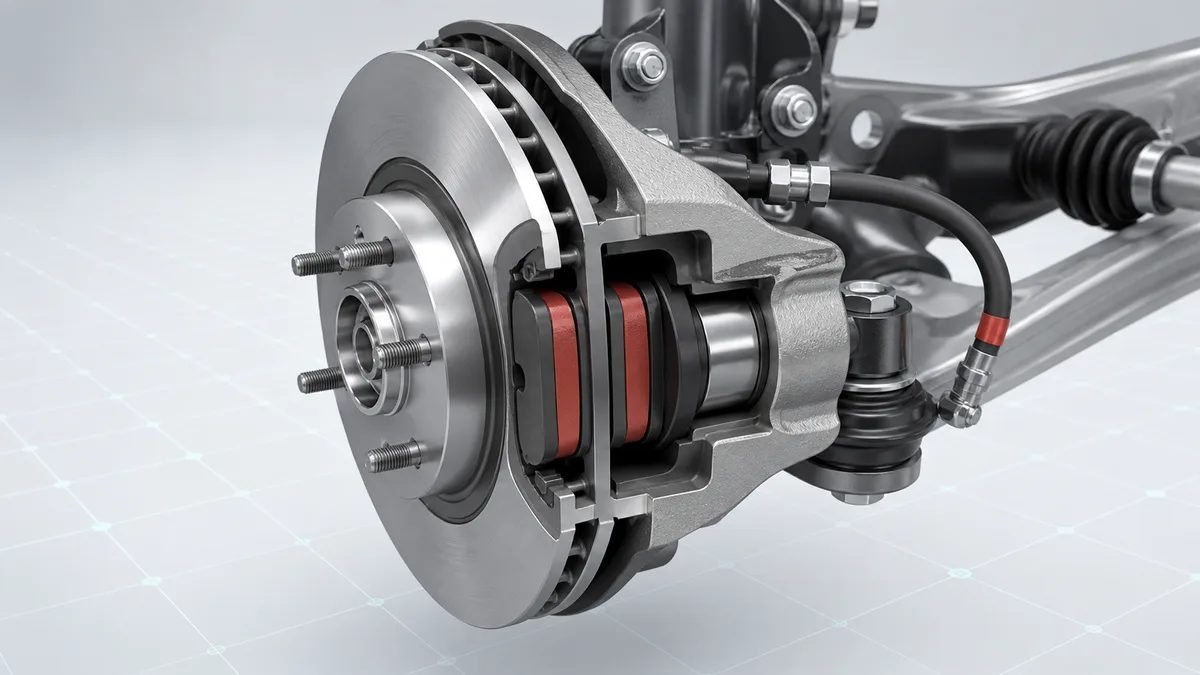
Four-wheel disc brakes consist of a disc at each wheel that rotates at wheel speed and is straddled by a caliper that squeezes the inner and outer faces of the disc to provide stopping or braking powerChecked 2026-08-16
Brake pads, rotors and calipers
The friction parts at each wheel: the caliper squeezes pads against a rotating disc to slow the car.
Also called: disc brakes · brake discs · brake pads · brake calipers
What it means
Definition
In a disc brake, the rotor turns with the wheel. A caliper straddles that rotor and uses one or more pistons to press friction pads against its faces. The resulting friction converts the vehicle’s motion into heat and slows the wheel.
Why a buyer cares
What it changes
Pads are routine wear parts; rotors may be reused, machined or replaced depending on condition and specification; a caliper is a separate hydraulic component. A quote should say which parts and which axle it covers.
In practice
Where you meet it
On brake inspection measurements and repair estimates, usually listed separately for the front and rear axles.
Two things that look alike
Not the same as
ABS controls brake pressure during wheel slip; pads, rotors and calipers create the base braking force.
Read next
Related terms
Anti-lock Braking System (ABS)
The part of the brake system that controls wheel slip during braking so the wheels do not lock.
Brake master cylinder and booster
The master cylinder creates hydraulic pressure; the booster reduces how hard the driver must press.
Brake rotor thickness variation (DTV)
Uneven rotor thickness around the disc, felt as a pulsing brake pedal.
Where this comes from
Sources
Minimum pad and rotor measurements are vehicle-specific and are deliberately not generalized here.