Automatic transmissions have hydraulically operated gear sets that require no gear shifting or clutching by the driverChecked 2026-08-16
Automatic transmission
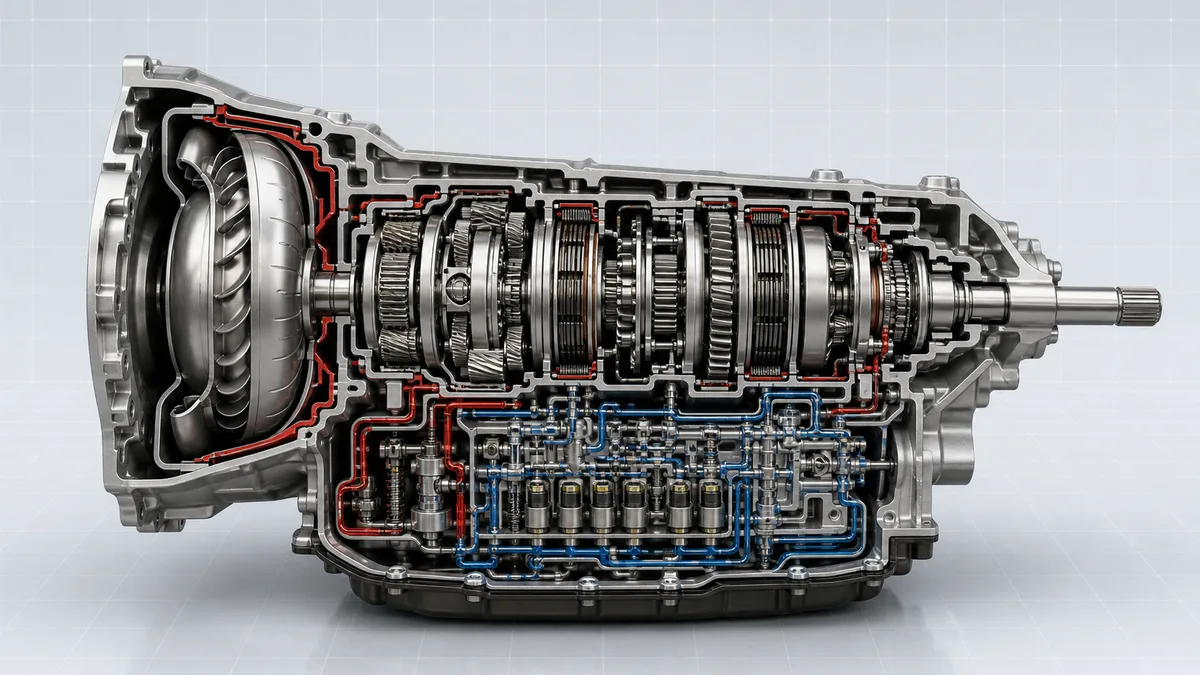
A transmission that selects its own gear ratios instead of asking the driver to use a clutch pedal.
Also called: automatic gearbox · auto transmission · AT
What it means
Definition
A transmission changes the ratio between engine speed and wheel speed and also provides neutral and reverse. In a conventional automatic, hydraulic clutches and gearsets are commanded by fluid pressure and electronic controls, so the driver selects a range such as Drive rather than each individual gear.
Why a buyer cares
What it changes
‘Automatic’ is a broad label. A conventional automatic, CVT and dual-clutch transmission drive differently and use different internal parts, so the exact type matters when reading a specification or service record.
In practice
Where you meet it
In a listing’s transmission field, on the gear selector and in fluid or repair records.
Two things that look alike
Not the same as
A CVT and a dual-clutch transmission can both shift automatically, but neither is the same mechanism as a conventional hydraulic automatic.
Read next
Related terms
Continuously variable transmission (CVT)
An automatic that uses variable-diameter pulleys instead of a fixed set of gears.
Dual-clutch transmission (DCT)
An automatic built from two gearsets, each with its own clutch, so the next gear is pre-selected.
Torque converter
The fluid coupling between an engine and a conventional automatic transmission.
Transmission fluid service
Draining and refilling transmission fluid, on whatever schedule the maker publishes — or none.
Where this comes from
Sources
This describes a conventional automatic. Some manufacturer literature also uses ‘automatic’ as an umbrella term for CVTs and dual-clutch units.