With the wideband lambda sensor, the oxygen concentration in the exhaust gas can be determined over a wide range for calculation of the air/fuel ratio in the combustion chamber.Checked 2026-08-16
Oxygen sensor (lambda sensor)
An exhaust sensor that reports oxygen concentration so the engine computer can monitor mixture and catalyst operation.
Also called: O2 sensor · lambda sensor · air-fuel ratio sensor · AFR sensor
What it means
Definition
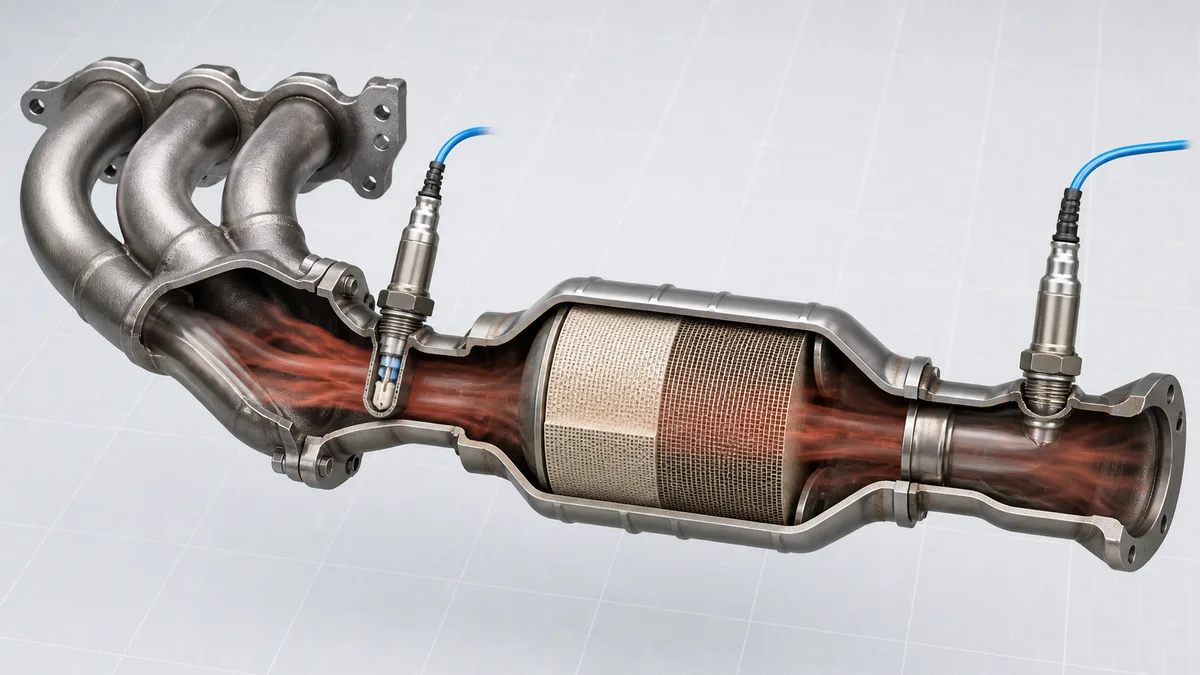
An oxygen or lambda sensor measures oxygen concentration in exhaust gas. An upstream sensor helps the engine computer correct the air-fuel mixture; a downstream sensor is commonly used to monitor catalytic-converter performance. Wideband air-fuel ratio sensors perform the same broad measurement over a wider range but use different signals.
Why a buyer cares
What it changes
‘Oxygen-sensor code’ does not always mean a failed sensor. Wiring, exhaust leaks, mixture faults and a damaged catalyst can all influence the signal, and bank and sensor position identify different locations.
In practice
Where you meet it
In emissions diagnosis and codes naming O2, lambda, AFR, bank 1 or 2, and sensor 1 or 2.
Two things that look alike
Not the same as
The MAF measures intake air before combustion; the oxygen sensor reads exhaust after combustion.
Read next
Related terms
Catalytic converter
An exhaust device that uses catalyst materials to convert harmful gases into less harmful emissions.
Mass airflow and MAP sensors
The MAF measures incoming air mass; the MAP sensor measures intake-manifold pressure.
Malfunction Indicator Lamp (MIL)
The dashboard lamp — usually labelled Check Engine — that the OBD-II system switches on when it confirms a fault.
Where this comes from
Sources
Sensor naming and upstream/downstream monitoring strategy vary by engine and emissions system.