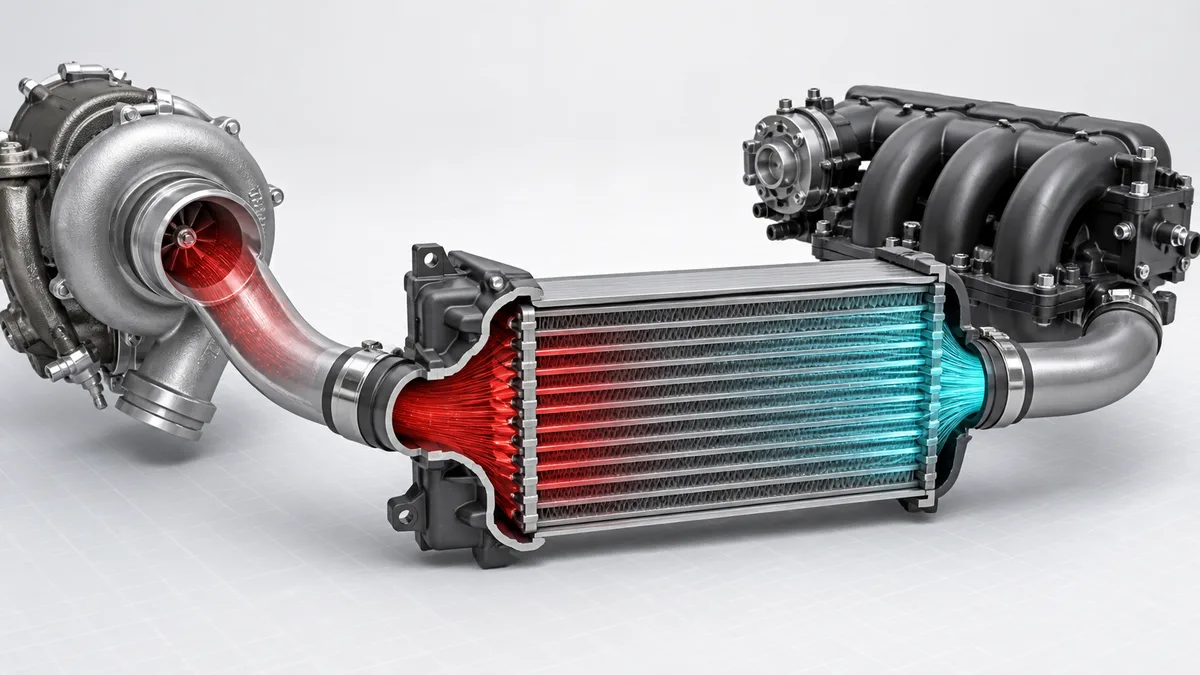
Used on supercharged and turbo charged vehicles, the inter cooler is mounted at the front of the vehicle in the air stream and cools the compressed intake air as it flows over fins and plates inside the inter cooler.Checked 2026-08-16
Intercooler (charge-air cooler)
A heat exchanger that cools the compressed intake air leaving a turbocharger or supercharger.
Also called: charge-air cooler · CAC · boost cooler · inter cooler
What it means
Definition
Compressing intake air raises its temperature. An intercooler passes that charge air through a heat exchanger before it enters the engine, lowering its temperature and increasing its density. Depending on the vehicle, outside air or a separate liquid circuit carries the heat away.
Why a buyer cares
What it changes
The intercooler is on the intake side, not the engine-coolant radiator. Leaks in its hoses or core can lose boost pressure even when there is no coolant leak.
In practice
Where you meet it
In turbocharged-engine specifications and on estimates naming charge pipes, boost hoses or a charge-air cooler.
Two things that look alike
Not the same as
A radiator cools engine coolant; an intercooler cools compressed intake air.
Read next
Related terms
Turbocharger
An exhaust-driven compressor that forces extra air into the engine.
Engine cooling system
The coolant circuit, pump, thermostat, radiator and fan that move engine heat into the outside air.
Mass airflow and MAP sensors
The MAF measures incoming air mass; the MAP sensor measures intake-manifold pressure.
Where this comes from
Sources
Some systems use a liquid-cooled charge-air cooler rather than the air-to-air layout described in the source quote.