This heat is absorbed at the heat source by the coolant circulating in the cooling circuit and dissipated at a heat sink.Checked 2026-08-16
Engine cooling system
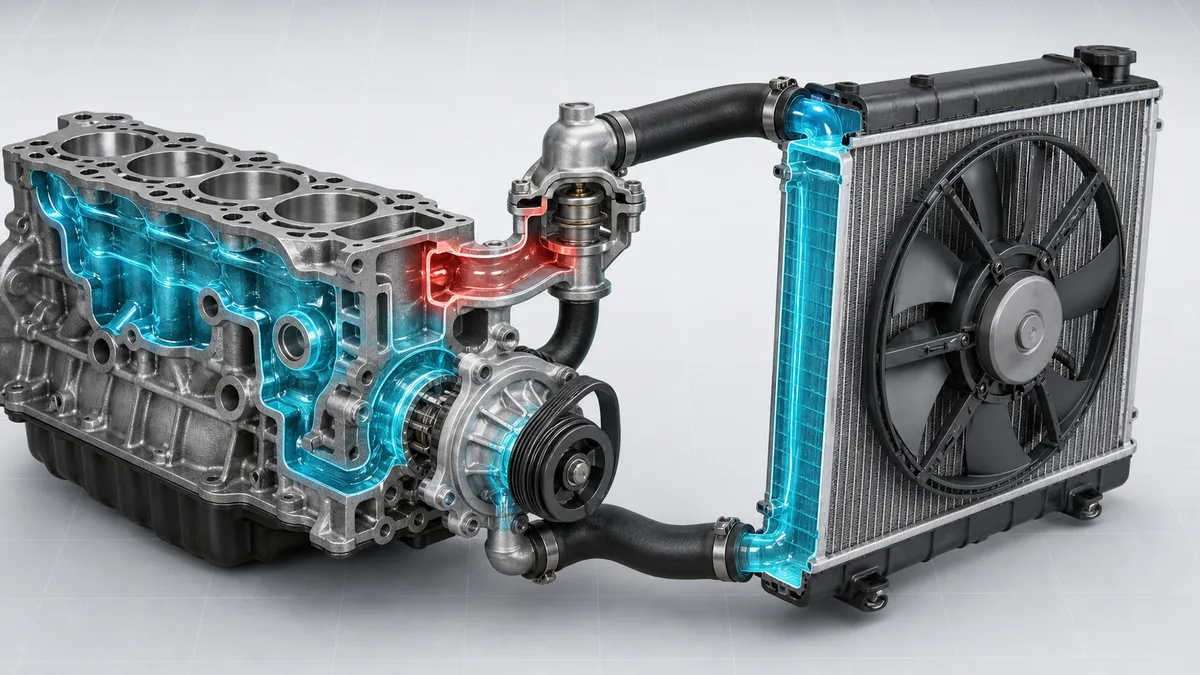
The coolant circuit, pump, thermostat, radiator and fan that move engine heat into the outside air.
Also called: radiator · coolant pump · water pump · thermostat · cooling fan
What it means
Definition
Coolant absorbs heat as it circulates through the engine. The pump keeps it moving, the thermostat regulates when the radiator circuit opens, the radiator transfers heat to outside air, and the fan maintains airflow when road speed is not enough. The expansion tank gives the heated coolant room to change volume.
Why a buyer cares
What it changes
‘Overheating’ names the result, not the failed part. Low coolant, a leak, poor circulation, blocked airflow or a control fault can all raise temperature, so the repair should identify the cause and the effect.
In practice
Where you meet it
Under the hood at the coolant reservoir and on estimates naming a radiator, water pump, thermostat or cooling fan.
Two things that look alike
Not the same as
The cabin heater uses heat from the cooling circuit, but a heater-core problem is not the same as a radiator problem.
Read next
Related terms
Where this comes from
Sources
An engine cooling fan that combines maximum efficiency with the lowest possible noise level can be used to ensure air flow through the heat exchanger in case of insufficient driving speedChecked 2026-08-16
Some engines use multiple pumps, valves and cooling circuits; the entry describes the shared basic function.