The fuses are designed to blow, protecting the wiring harness from damage.Checked 2026-08-16
Fuses and relays
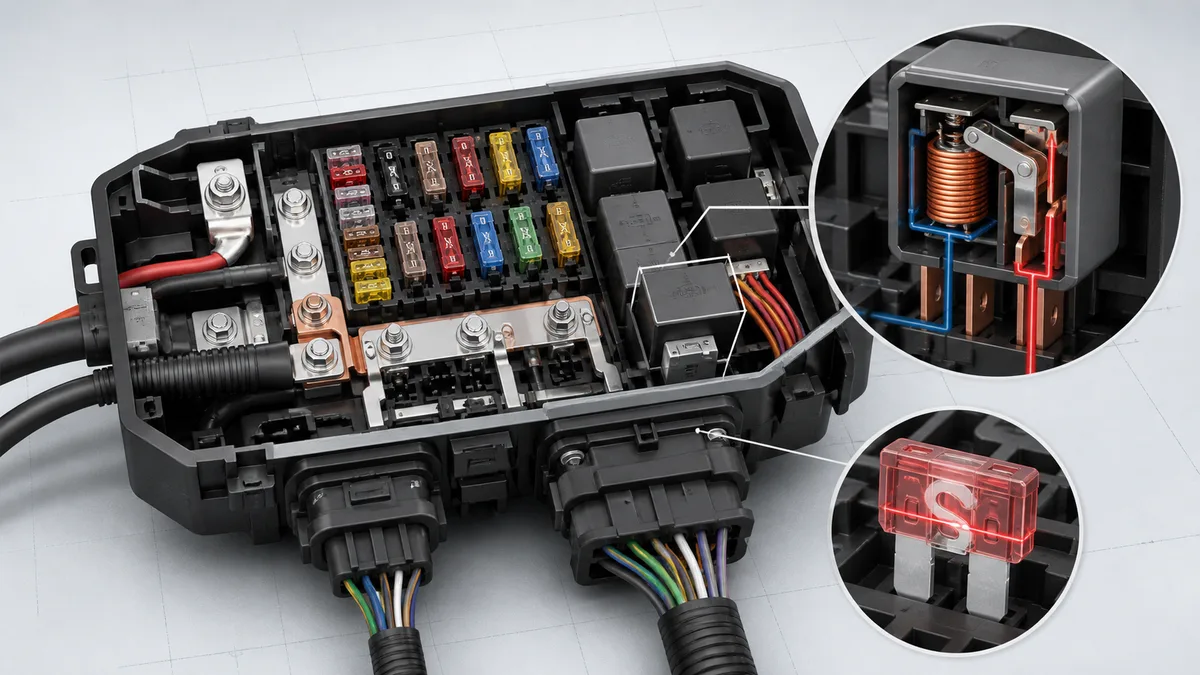
A fuse opens an overloaded circuit; a relay lets a low-current control switch a higher-current circuit.
Also called: fuse box · power distribution box · relay · fusible link
What it means
Definition
A fuse contains a link designed to open when current exceeds its rating, protecting the circuit’s wiring. A relay is an electrically operated switch: a control circuit energizes it so another circuit can be connected or disconnected without sending the full load through the control switch.
Why a buyer cares
What it changes
A blown fuse is evidence of an overload, not always the root cause. Replacing it with a higher rating removes intended protection; swapping a relay is only meaningful when the terminal layout and rating match.
In practice
Where you meet it
In under-hood and interior fuse panels, owner’s-manual diagrams and electrical diagnosis.
Two things that look alike
Not the same as
A fuse protects a circuit by opening; a relay repeatedly switches a circuit during normal operation.
Read next
Related terms
12-volt battery
The low-voltage battery that powers control systems and, on combustion cars, supplies starter current.
Powertrain Control Module (PCM)
The onboard computer that runs the engine and, on many cars, the transmission.
Diagnostic Trouble Code (DTC)
The code an OBD-II system stores to identify which monitored system it found a fault in.
Where this comes from
Sources
A system for engine management consists of a broad range of electrical and electronic components. These include sensors, relays, actuators, and an engine control unit (ECU).Checked 2026-08-16
The relay-switching explanation is standard electrical operation; the cited DENSO page establishes relays as engine-management components but does not define their internals.